Best Crochet Hook Size for Amigurumi: Complete Guide
If you’ve ever followed an amigurumi pattern only to end up with a toy that looked much larger, softer, or looser than the designer’s sample, the crochet hook was probably one of the biggest reasons why. While yarn usually gets most of the attention, the hook size you choose has an enormous impact on the finished shape, stitch definition, firmness, and overall quality of your amigurumi.
Unlike garments or blankets, amigurumi requires a dense fabric that can hold stuffing without stretching or revealing gaps between stitches. This means the hook recommended on a yarn label is often not the best hook for crochet toys.
So how do you choose the right crochet hook?
In this complete guide, you’ll learn how hook size affects amigurumi, how to match hooks with different yarn weights, when to size up or down, and how to find the perfect combination for your own crochet tension.
Why Hook Size Matters More in Amigurumi
The crochet hook determines the size of every stitch you create.
A larger hook produces larger loops, which creates a softer and more flexible fabric. A smaller hook creates tighter stitches, resulting in a firmer and more compact texture.
For clothing, loose stitches often improve drape and comfort. For amigurumi, however, the opposite is usually true.
A properly chosen hook helps you create:
- smooth stitch definition
- minimal gaps between stitches
- better support for stuffing
- cleaner shaping
- stronger structure
- more professional-looking toys
Even changing the hook by 0.5 mm can noticeably affect the finished result.
The Biggest Beginner Mistake
One of the most common mistakes is using the hook size printed on the yarn label.
Yarn manufacturers usually recommend hooks intended for garments, scarves, or blankets—projects where softness and flexibility are desirable.
For example, a cotton yarn might recommend a 4.0 mm hook.
For amigurumi, many crocheters would instead use a 3.0 mm or 3.5 mm hook with that same yarn.
The smaller hook creates a tighter fabric without changing the yarn itself.
As a general rule, amigurumi hooks are often one to two sizes smaller than the label recommendation.
How Hook Size Changes Your Amigurumi
Let’s imagine you’re crocheting the same teddy bear using identical yarn but different hooks.
| Hook | Result |
|---|---|
| 2.5 mm | Very firm, compact stitches, smallest size |
| 3.0 mm | Dense fabric with excellent stitch definition |
| 3.5 mm | Slightly softer but still suitable for most projects |
| 4.0 mm | Larger toy with more visible gaps |
| 5.0 mm | Loose fabric that may expose stuffing |
The stitch pattern hasn’t changed—only the hook.
This demonstrates how powerful hook selection really is.
A Quick Rule of Thumb
If you’re unsure where to begin, use this simple guideline.
| Yarn Weight | Starting Hook for Amigurumi |
|---|---|
| Lace | 1.5–2.0 mm |
| Fingering | 2.0–2.5 mm |
| Sport | 2.5–3.0 mm |
| DK | 3.0–3.5 mm |
| Worsted | 3.5–4.0 mm |
| Bulky | 5.0–6.0 mm |
These aren’t strict rules—they’re excellent starting points that you can adjust according to your personal tension.
Understanding Crochet Tension
Two crocheters can use the same yarn and hook while producing noticeably different results.
That’s because everyone has a unique crochet tension.
Tight crocheters
If you naturally pull the yarn firmly:
- stitches become smaller
- fabric feels rigid
- hands tire more quickly
You may benefit from choosing a slightly larger hook.
Loose crocheters
If your stitches tend to be relaxed:
- stuffing may become visible
- shaping feels softer
- toys become larger
A smaller hook often solves these problems.
The best hook is therefore not universal—it’s personal.
How to Find Your Perfect Hook Size
Rather than guessing, crochet a small test sphere.
Step 1
Choose your yarn.
Step 2
Crochet a simple sphere using one hook size.
Step 3
Stuff it firmly.
Step 4
Examine the surface.
Ask yourself:
- Can I see the stuffing?
- Are there noticeable gaps?
- Does the fabric feel too stiff?
- Does the sphere hold its shape well?
Repeat with another hook size if necessary.
This five-minute test can save hours on a larger project.
Cotton vs Acrylic: Does the Hook Change?
Yes.
Different fibers behave differently.
Cotton Yarn
Cotton has very little stretch.
It naturally creates crisp stitch definition, so many crocheters comfortably use relatively small hooks.
Example:
- Yarn: DK cotton
- Hook: 3.0 mm
Result: Firm, clean amigurumi with excellent definition.
Acrylic Yarn
Acrylic stretches more than cotton.
Using the same hook may produce a softer fabric.
Many makers compensate by choosing a slightly smaller hook than they would with cotton.
Example:
- Yarn: DK acrylic
- Hook: 2.75–3.0 mm
The goal is the same density despite the different fiber behavior.
When Should You Size Down?
Choose a smaller hook if you notice:
- stuffing showing through
- large gaps between stitches
- floppy limbs
- oversized finished toys
- weak stitch definition
Moving down only 0.25 mm or 0.5 mm is often enough.
You don’t necessarily need a dramatic change.
When Should You Size Up?
A hook that’s too small creates different problems.
Signs include:
- difficulty inserting the hook
- hand fatigue
- distorted stitches
- uneven tension
- very rigid fabric
Remember that amigurumi should be firm, not uncomfortable to crochet.
A slightly larger hook may actually improve consistency.
Hook Material Matters Too
The material of your crochet hook can influence your stitching experience.
Aluminum
- smooth
- durable
- excellent for cotton
- widely available
Steel
- ideal for tiny amigurumi
- common in miniature crochet
- available in very small sizes
Plastic
- lightweight
- comfortable for larger hooks
- often used with bulky yarn
Wooden Hooks
- warmer feel
- slightly more grip
- helpful if yarn slides too easily
The material won’t change stitch size directly, but it can affect your speed and control.
Ergonomic Hooks vs Traditional Hooks
If you crochet amigurumi frequently, ergonomic hooks are worth considering.
Their larger handles reduce hand strain during long sessions.
This is particularly helpful because amigurumi often requires thousands of tightly worked single crochet stitches.
Benefits include:
- reduced wrist fatigue
- improved grip
- better control
- longer comfortable crochet sessions
They’re especially useful for people who crochet daily or sell handmade toys.
The Best Hook Sizes for Popular Amigurumi Projects
Mini Amigurumi (5–10 cm)
- Yarn: Sport or fingering
- Hook: 2.0–2.5 mm
These projects rely on very small, precise stitches.
Medium Plush Toys (15–25 cm)
- Yarn: DK cotton
- Hook: 3.0–3.5 mm
This is one of the most versatile combinations.
Large Plush Animals (30 cm+)
- Yarn: Worsted
- Hook: 3.75–4.5 mm
The larger hook helps maintain comfortable stitching without sacrificing structure.
Velvet or Chenille Amigurumi
Chenille yarn behaves differently because it’s thick and soft.
Typical combinations include:
- Yarn: Chenille
- Hook: 4.5–6.0 mm
Even though the hook is larger, the plush yarn naturally fills the gaps between stitches.
Does Hook Size Change the Finished Size?
Absolutely.
A larger hook creates a larger toy, even if every stitch count remains identical.
For example:
| Hook | Approximate Height |
|---|---|
| 2.5 mm | 18 cm |
| 3.0 mm | 20 cm |
| 3.5 mm | 22 cm |
| 4.0 mm | 24 cm |
This makes hook size a useful way to resize patterns without changing the stitch instructions.
However, remember that proportions stay mostly the same—the entire character simply scales up or down.
Why Some Designers Recommend Different Hooks
You may notice that two amigurumi designers using the same yarn recommend different hooks.
Neither is necessarily wrong.
Possible reasons include:
- different crochet tension
- different design style
- desired firmness
- target audience
- fiber choice
Some designers prefer extremely compact collectible dolls.
Others intentionally create softer plush toys.
Always consider the finished look rather than copying the hook size blindly.
Should You Always Follow the Pattern?
Use the pattern as a starting point, not an absolute rule.
If the designer recommends a 3.5 mm hook but your stitches are loose, switching to 3.0 mm may produce a result much closer to the sample.
Likewise, if your stitches are unusually tight, 3.75 mm may be more appropriate.
Your own tension is just as important as the written instructions.
How Hook Size Affects Common Amigurumi Techniques
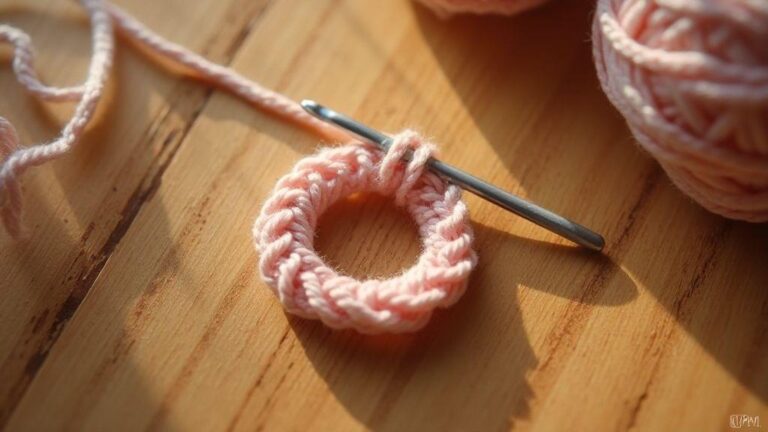
Magic Ring
A smaller hook creates a tighter center that closes more neatly.
Increases
Large hooks can make increases more visible because the stitches spread apart.
Decreases
Smaller hooks often produce cleaner invisible decreases.
Color Changes
Dense stitches help create sharper color transitions.
Embroidery
Firm fabric makes embroidered facial features easier to position accurately.
Almost every finishing detail benefits from consistent stitch density.
A Simple Hook Selection Formula
If you’re working with unfamiliar yarn, use this formula.
- Check the yarn label.
- Reduce the recommended hook by 0.5–1.0 mm.
- Crochet a small swatch or sphere.
- Stuff it firmly.
- Adjust if necessary.
For example:
| Label Recommendation | Start With |
|---|---|
| 5.0 mm | 4.0–4.5 mm |
| 4.0 mm | 3.0–3.5 mm |
| 3.5 mm | 2.5–3.0 mm |
This method works surprisingly well across many yarn types.
Common Questions About Hook Size
Can I use the same hook for every project?
You can, but it’s not ideal.
Different yarns perform best with different hook sizes.
Is smaller always better?
No.
A hook that’s too small can make crocheting uncomfortable and distort your stitches.
Why does my stuffing still show?
The problem may be:
- loose tension
- overstuffing
- slippery yarn
- inconsistent stitches
Hook size is important, but it’s only one factor.
Should beginners buy every hook size?
Not immediately.
A small collection covering 2.0 mm to 4.0 mm will handle most cotton amigurumi projects.
Building a Basic Amigurumi Hook Collection
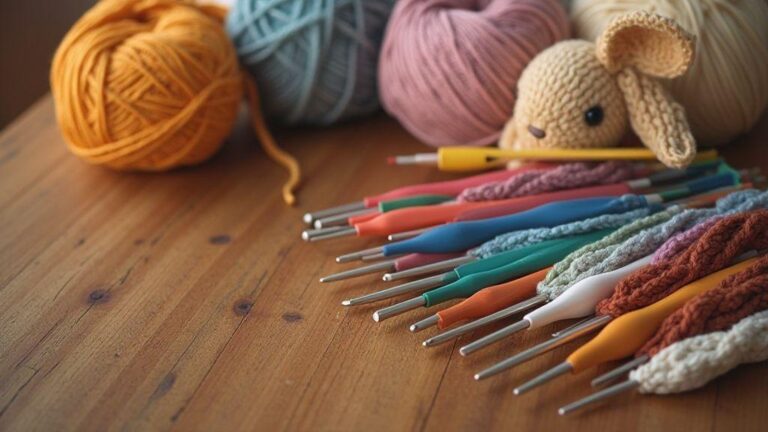
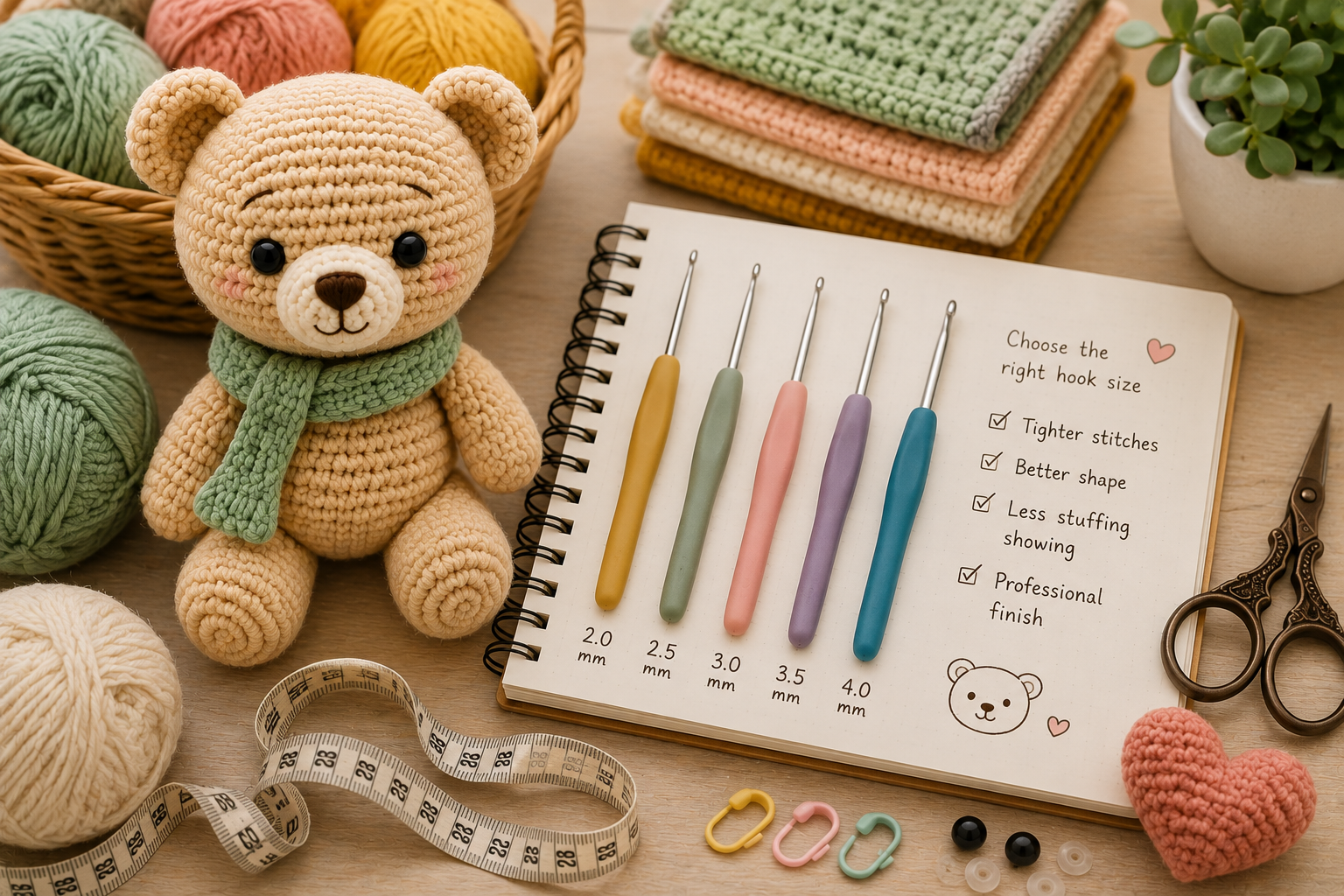
If you’re starting from scratch, these five hooks cover an enormous range of projects:
- 2.0 mm
- 2.5 mm
- 3.0 mm
- 3.5 mm
- 4.0 mm
With these sizes, you’ll be able to crochet everything from miniature animals to medium-sized dolls using most common yarn weights.
As your projects become more specialized, you can add finer steel hooks or larger hooks for plush yarn.
Final Thoughts
Choosing the right crochet hook is one of the simplest ways to improve your amigurumi immediately.
Rather than automatically following the yarn label, focus on creating a dense, smooth fabric that supports stuffing while remaining comfortable to crochet. For most projects, this means selecting a hook one or two sizes smaller than the standard recommendation, then adjusting according to your personal tension.
Remember that there is no universally perfect hook size. The ideal combination depends on your yarn, your crochet style, and the type of character you’re creating.
When in doubt, crochet a small test piece, stuff it firmly, and let the fabric tell you whether the hook is right.
A difference of just 0.5 mm may seem small—but in amigurumi, it can be the difference between a handmade toy that looks homemade and one that looks truly professional.
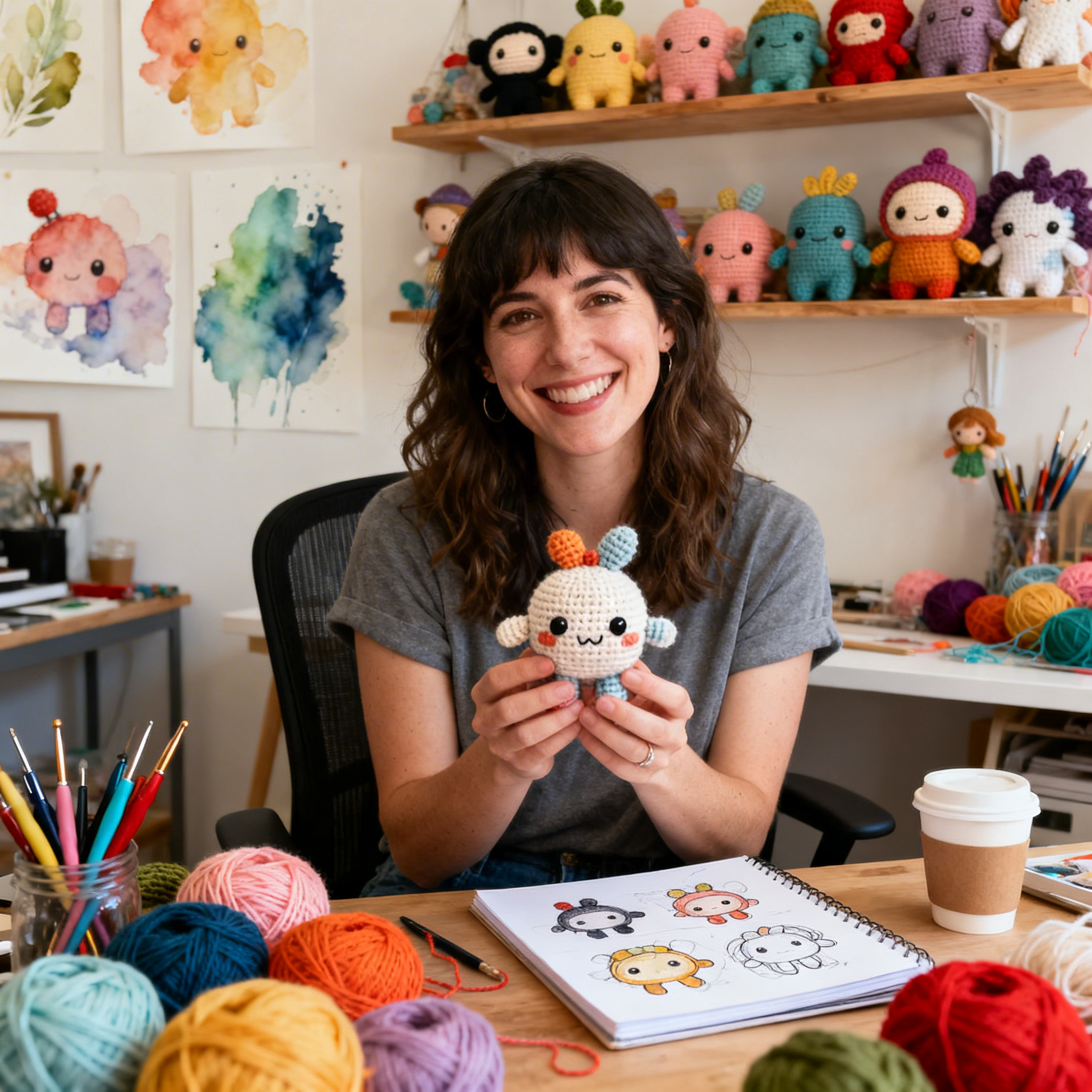
Clara Fern — Crochet Artist & Amigurumi Designer
Clara Fern is a crochet artist and amigurumi designer based in Austin, Texas. With 9 years of experience working with yarn and hook, she transformed a lifelong passion for handcraft into a creative mission: making amigurumi accessible, fun, and deeply rewarding for crafters of all levels.
Clara discovered amigurumi during a trip to Japan in 2017, where she fell in love with the art of bringing tiny characters to life through crochet. Back home in Texas, she spent years studying color theory, design principles, and advanced crochet techniques — developing her own signature style that blends kawaii aesthetics with original character design.
Through maclafersa.com, Clara shares everything she has learned — from choosing the right yarn and reading your first pattern, to designing fully original amigurumi characters from scratch. Her writing is known for being clear, detailed, and genuinely helpful, with no steps skipped and no secrets kept.
When she’s not crocheting, Clara enjoys watercolor painting, visiting local yarn shops, and drinking way too much coffee while sketching new character ideas.