How to Design Large Amigurumi Without Losing Structural Integrity
Yarn and Hook Choice for Large Plush
You’re aiming for a plush that holds its shape, so choose a sturdy mid-weight yarn such as acrylic blends with good snap and bounce. Look for fibers that resist stretching and pilling. Test a small swatch to see how the fibers behave under gentle tugs. Pair this with a hook size that’s slightly smaller than the yarn label recommends to lock in detail from the start. For big pieces, a slightly tighter gauge helps establish a solid silhouette.
Consider the project’s major moments—arms, legs, and the torso. A yarn with some weight helps maintain a strong shape, while too-slippery fibers can soften curves. If the plush must endure hugs, pick yarn that resists fuzz and holds color well. Remember, the hook choice affects stitch tightness and overall sturdiness, so balance yarn strength with the hook’s bite.
When selecting yarn, think about color needs and finishing touches. Consistent thickness across skeins keeps stitches even in large areas. For multi-color designs, test color changes in a mock piece to ensure clean transitions. The goal is a fabric that doesn’t gap or sag, with secure, uniform stitches from edge to edge.
Pick fiber for long lasting strength
For long-lasting strength, choose fibers that resist stretching and hold their shape. Acrylic blends are durable and easy to clean, ideal for large amigurumi. If you prefer a softer touch, look for blends with nylon or polyester for extra resilience. Balance softness with structural integrity so your giant plush remains sturdy over time.
Natural fibers can look gorgeous but behave differently at scale. Wool, for example, can felt or add weight, which isn’t always ideal for beginners. If you stick with natural fibers, opt for a sturdy wool blend and expect slightly tighter stitching to maintain shape. The aim is a plush that keeps its pose after many hugs.
Use a smaller hook to tighten stitches
A hook that’s smaller than the yarn’s standard recommendation tightens stitches, producing a denser fabric that supports rigidity in large pieces. Test a few stitches to find a snug but comfortable tension so the shape remains readable.
Tight stitches help blend pieces smoothly. With bigger joints, the extra density covers gaps and reduces stuffing leaks. Practice with a test square to dial in the exact hook size you need. The final choice should give you confidence that every part stays solid after handling.
Tighter stitches help large amigurumi structural integrity
Tight stitches keep the model together and resist droop under weight and motion. The right stitch tension matters most for a sturdy shell. Steady hands and deliberate rows pay off in a strong finish.
Tight stitches also help stuffing stay evenly distributed. If you see gaps or hollows, you likely need denser work or a stronger yarn. Consistent tension reduces visible seams and maintains a clean silhouette from head to toe.
Add an Internal Armature for Support
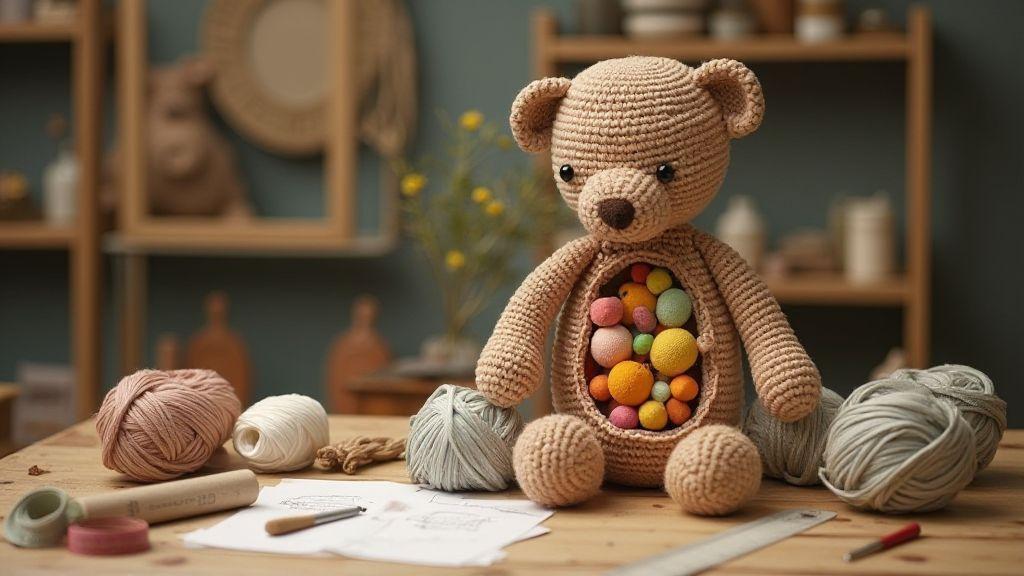
An internal armature provides stability, acting as the skeleton that prevents droop or twist under load. Start with a light, bendable core that fits inside the shape, wrap it with gradually tighter layers of stuffing, then cover with yarn. Test by tugging limbs to feel for wobble and reinforce as needed. The goal is a backbone that holds every limb in place while still allowing pose.
Distribute stress evenly with a flexible core that bends naturally along joint lines. If a limb feels sharp or uneven underneath, reinforce the area before finishing seams. Plan your armature around your final pose—sketch an inside map to place pieces correctly and avoid reworks.
Types of internal armature for amigurumi
You’ll find several options, each with pros and cons. A simple pipe-cleaner core works for small projects; for larger pieces, use a flexible wire frame wrapped with stuffing to hide the metal. A foam core insulated with stuffing offers a lightweight alternative that still holds a pose. A heat-safe, low-profile armature wire wrapped tightly with fabric or batting creates a smooth surface while keeping joints movable. For worry-free handling, pair this with a soft outer cover.
A combination armature—light core with extra support at high-stress areas like knees and elbows—lets you keep weight down while preventing sag. Test early by shaping the armature into the intended position and checking resistance to shifting during handling.
Pad and cover armature to prevent pokes
Pad the armature with soft stuffing or fabric to hide metal edges and create a cushioned feel. Wrap the core with batting and shape the outer form, then cover completely with your yarn using tight stitches to prevent gaps. Check inner lighting to ensure filling stays hidden, especially with light-colored yarn. Tuck yarn ends neatly to maintain a smooth surface.
Test the armature surface by pressing gently to avoid hard spots. If needed, add padding or redistribute stuffing for a consistently soft finish.
Secure the armature inside the core
Anchor the armature at key points to prevent shifting. Fix the spine and major joints first, then add supportive ties or small stitches to hold everything in place. Ensure the armature sits centered within the core to avoid a lopsided base. Do a final pose test after outer layers go on to confirm stability.
How to Design Large Amigurumi Without Losing Structural Integrity: Scaling Patterns
Designing large amigurumi is a fun challenge: you want size without wobble. Scaling patterns preserves the original design’s magic while maintaining strength. Think in ratios and supports, not just dimensions. Bigger toys need stronger bones, so apply the same core techniques—tight stitches, fewer holes, and deliberate increases and decreases—adjusted for scale. Map new dimensions, choose body-friendly yarn, and pick a hook that keeps stitches firm. Test with a small sample first to confirm the scale holds together.
Scaling reveals how your design breathes at larger sizes. Treat your pattern like a blueprint and your model like sculpture—small proportional shifts can change the whole look. With the right approach, you’ll obtain a large amigurumi that’s as solid and lovable as its smaller version.
Follow scaling amigurumi patterns step by step
When scaling, measure your original pattern’s key points (height, limb length, round counts), decide the new size, and apply a uniform scaling factor. Maintain stitch density by using a yarn and hook that preserve gauge, ensuring the final piece doesn’t sag. Translate increase/decrease rules to the new scale and test fit as you go by pinning pieces together to check balance before finishing. Document every change for repeatability.
Keep shaping ratios when you scale up
Preserve the same visual ratios from the original. If the head is 40% of height in the small version, keep that proportion in the large one. Use consistent percentage relationships when adjusting the body, arms, and legs to avoid an accidental lump. Compare scaled pieces side by side to spot drift and make small proportional tweaks to restore balance.
Balance increases and decreases evenly
When increasing size, adjust features in pairs to maintain balance (e.g., larger head needs a proportionally larger neck). If you enlarge one part, offset with a corresponding downshift elsewhere to keep the silhouette cohesive. Test the model’s stability by placing it upright and nudging gently; if it wobbles, re-balance the ratios.
Control Stitch Tension for Large Crochet Strength
Stitch tension is the backbone of large crochet. Consistent tension keeps edges straight and fabric sturdy, preventing sag over time. With bulky yarns, practice a steady rhythm to keep rows even and seams nearly invisible. Find a comfortable hook size that matches your yarn and project, and monitor for tighter or looser stitches across the fabric.
Practice helps you develop a tension map: note yarn, hook size, and stitch type, then track when tension feels off. The goal is even, balanced stitches that resist puckering and distortions, giving your large designs strength from corner to corner.
Practice stitch tension control for large crochet
Try drills with a wide swatch to feel how grip affects each loop. If tension tightens mid-row, slow your pace and relax your grip. Maintain a tension log to record which adjustments improve consistency over time.
Make gauge swatches for big pieces
Gauge swatches are crucial for large pieces. Use the same yarn, hook, and tension, and create a wide swatch that mimics your final shape. Measure stitches per inch and rows per inch across multiple spots; adjust hook size or tension if needed. Build a test section that mirrors the final piece to predict behavior at scale.
Even tension prevents holes and sag
Even tension minimizes gaps and sag in large work. Slow, deliberate stitches help lock in uniform loops and prevent holes at joins. Continuously monitor fabric density to maintain a sturdy surface, especially where weight is supported.
Stuffing Techniques for Even Firmness
Smart stuffing yields even firmness without hard blocks or jelly-soft sag. Choose materials that suit the project, and pack thoughtfully. Test by poking to identify soft or stiff areas and adjust accordingly. Build from the inside out with layered stuffing to ensure even support, allowing you to pose the head, torso, and limbs without creasing.
Density matters: stuffing too much in one area creates lumps; gaps cause flattening. Layer and compress gradually, using scraps for small gaps. Regularly test from multiple angles to maintain a clean silhouette and professional finish.
Use stuffing techniques for even firmness
Divide the project into sections and fill each with care. Build core first, then surrounding layers to support the outer skin. Maintain consistent pressure, adding small amounts at a time and redistributing if you notice lumps. Practice yields predictable resistance and repeatable results for future projects.
Layer and compact stuffing from center out
Starting from the center provides a solid core to expand from. Pack the middle first, then add outer rings in steps, compacting each layer to avoid air pockets. This method helps you shape ears, limbs, and facial features without collapse, while maintaining balance.
Stage stuffing to avoid lumps
Stage stuffing to assess how material settles. Smooth lumps with fingers or a blunt tool and redistribute stuffing to adjacent areas. Recheck from all angles with a four-point inspection to catch uneven spots. Staging stuffing well results in a polished, professional-looking piece.
Reinforcing Joints in Amigurumi
Joints are the puzzle pieces that keep the toy moving naturally. Use reinforced stitches at limb joins and bends to improve durability. Think of it as a safety belt: not flashy, but essential for long-lasting resilience. Reinforce high-stress joints with snug stitches and extra yarn if needed.
Use reinforcing joints in amigurumi at stresses
Place reinforcing stitches at high-stress points as you seam the limbs. Consider slightly thicker yarn or dotted stitches to increase grip. Ensure tension is even to avoid a lopsided look. If needed, a tiny dab of fabric glue inside the seam can add staying power after full drying.
Add extra rows or lining at limb joins
Additional rows or a thin lining at limb joins can absorb stress and prevent seam unraveling. A light internal reinforcement disk can distribute load in larger pieces. Reinforced joints handle play and weight better, keeping the limb secure during handling.
Reinforced joints handle play and weight
Reinforced joints resist wobble during hugs and handling. They help preserve pose after long pretend-play sessions and keep the piece looking new longer. Combine solid seams with targeted reinforcement to maintain softness alongside durability.
Weight Distribution for Stable Amigurumi
Proper weight distribution keeps your figure upright and poseable. Heavier mass belongs lower to lower the center of gravity, while lighter areas stay higher for balance. Map the heaviest parts early—torso and base—and consider pellets or dense cores at the bottom for stability.
Plan how to add weight—pellets or beads in a contained pouch at the base works well, with stuffing remaining to shape the rest. Test stability on a flat surface, adjusting weight and footprint as needed. The aim is a steady, self-supporting statue you can pose confidently.
Plan weight distribution for stable amigurumi
Sketch where the heaviest parts should live, usually the torso and base. Use a contained weight method to avoid shifts, such as a small fabric pouch with pellets sewn into the base. Test and adjust as you go to maintain a firm center of gravity and reliable pose.
Place heavier fill low or use pellets in base
Anchor the base with heavier fill at the bottom to stabilize the figure without creating visible bulk. A base disc can distribute weight evenly and prevent edge bulges. If the piece has a wide stance, distribute weight more broadly at the base while keeping arms and head flexible for posing.
Base and Limb Support Methods
A sturdy base and well-planned limb support keep large amigurumi standing tall and posing reliably. Wide feet and broad contact points improve stability on different surfaces. Design the feet and legs to work as a unit with the torso to keep the hips level and the center of gravity low.
A wider base reduces tipping on carpets or uneven floors and provides a stable platform for any pulling from limbs. Map weight distribution at joints to ensure the legs anchor the body and the feet offer solid contact. Balance is key; test on various surfaces and adjust as needed.
Use base and limb support methods like wide feet
Wide feet give immediate stability and prevent tipping. Crochet extra stitches to widen the base and, if needed, compress the soles with a touch of stuffing to keep them rigid. Shape feet to match limb length, and consider a felt insert under each foot for extra grip. Test on different floor types to fine-tune width for upright stability.
If you want more stability, pair wide feet with a heavier base and a low center of gravity. The result is a plush that stands confidently and remains adorable in dynamic poses.
Strengthen sockets with internal rings or discs
Insert small internal rings or discs inside joints to prevent sockets from spreading under pressure. For larger figures, double-wrap the socket or reinforce with a sturdier core before the outer shell. Test by moving joints through common poses to ensure smooth motion and stable anchoring.
If repairing an older piece, these internal supports can restore stability. Use simple rings or discs from a craft store and insert before finishing the outer layer.
Solid bases cut wobble and strain
A solid base reduces wobble and joint strain. Use a flat, dense internal surface, optionally covered with a matching fabric. Anchor the base with a few stitches or a dab of glue to prevent shifting during handling or display. Test from multiple directions and reinforce if needed.
Seamless Construction for Strength and Finish
Seamless construction combines strength with a clean finish. It minimizes weak points and creates a smooth surface ideal for painting, stitching, or decoration. Align edges and maintain even layers to reduce snag points and seam visibility, producing a polished, gallery-ready look.
Use seamless joins to create a stronger backbone, ensuring less movement at joins and crisper shapes after handling or shipping. Plan pattern edges to meet naturally, reducing the need for bulky fillers. Before final closing, test connections with wiggles and taps to catch weaknesses early, and finish with hidden stitches for durability.
Test connections before final closing
Check every connection with gentle tests. If a join shifts or gaps under pressure, reinforce before finishing. Note spots needing extra adhesive or realignment to save time later and ensure a smooth final product.
Finish with hidden stitches for durability
Hidden stitches give a clean exterior while delivering lasting strength. Practice consistent stitch length and spacing so the seam remains barely noticeable yet durable. Hidden stitches resist catching on surfaces and maintain integrity through repeated use.
How to Design Large Amigurumi Without Losing Structural Integrity: Quick Recap
How to Design Large Amigurumi Without Losing Structural Integrity requires planning, scaled balance, and reinforced structures. From choosing the right yarn and hook to implementing internal armatures and seamless joins, every step strengthens the final piece. Use gauge swatches and tension control to keep large projects solid from edge to edge, then apply measured stuffing and weight distribution to prevent wobble. With thoughtful design and careful testing, your large amigurumi will stay poseable, cuddly, and true to your original concept.

Clara Fern — Crochet Artist & Amigurumi Designer
Clara Fern is a crochet artist and amigurumi designer based in Austin, Texas. With 9 years of experience working with yarn and hook, she transformed a lifelong passion for handcraft into a creative mission: making amigurumi accessible, fun, and deeply rewarding for crafters of all levels.
Clara discovered amigurumi during a trip to Japan in 2017, where she fell in love with the art of bringing tiny characters to life through crochet. Back home in Texas, she spent years studying color theory, design principles, and advanced crochet techniques — developing her own signature style that blends kawaii aesthetics with original character design.
Through maclafersa.com, Clara shares everything she has learned — from choosing the right yarn and reading your first pattern, to designing fully original amigurumi characters from scratch. Her writing is known for being clear, detailed, and genuinely helpful, with no steps skipped and no secrets kept.
When she’s not crocheting, Clara enjoys watercolor painting, visiting local yarn shops, and drinking way too much coffee while sketching new character ideas.