How to Choose the Right Stuffing for Amigurumi Toys
Choosing yarn and a crochet hook usually gets most of the attention when starting an amigurumi project, but there’s another material that can dramatically influence the finished result: the stuffing.
The filling inside an amigurumi determines much more than how soft the toy feels. It affects the character’s shape, firmness, weight, durability, stitch appearance, and even how well the finished piece holds its proportions over time.
Use the wrong stuffing and a carefully crocheted character can end up lumpy, flat, overly rigid, or unable to support its own head. Use the right material and proper stuffing technique, and the same crochet pattern can look smooth, balanced, and professionally finished.
There isn’t one universal filling that’s perfect for every project. The best choice depends on the size of the amigurumi, its intended use, the desired texture, whether it needs additional weight, and whether the finished toy will be washable.
In this guide, we’ll look at the most common stuffing materials for amigurumi and how to choose the right one for your project.
Why Stuffing Matters in Amigurumi
Crochet creates the outer structure of an amigurumi, but stuffing gives that structure its final three-dimensional form.
Imagine crocheting two identical spherical heads.
If one is lightly stuffed, it may look soft and slightly flattened. If the second is stuffed more firmly, it can become noticeably rounder and more defined even though both pieces have exactly the same number of stitches.
This is why stuffing should be considered part of the shaping process.
The right filling helps:
- maintain the intended shape
- support larger heads and bodies
- create smooth surfaces
- define curves and proportions
- prevent hollow or collapsed areas
- control the softness of the finished toy
Your choice should therefore be based on what you want the finished amigurumi to look and feel like.
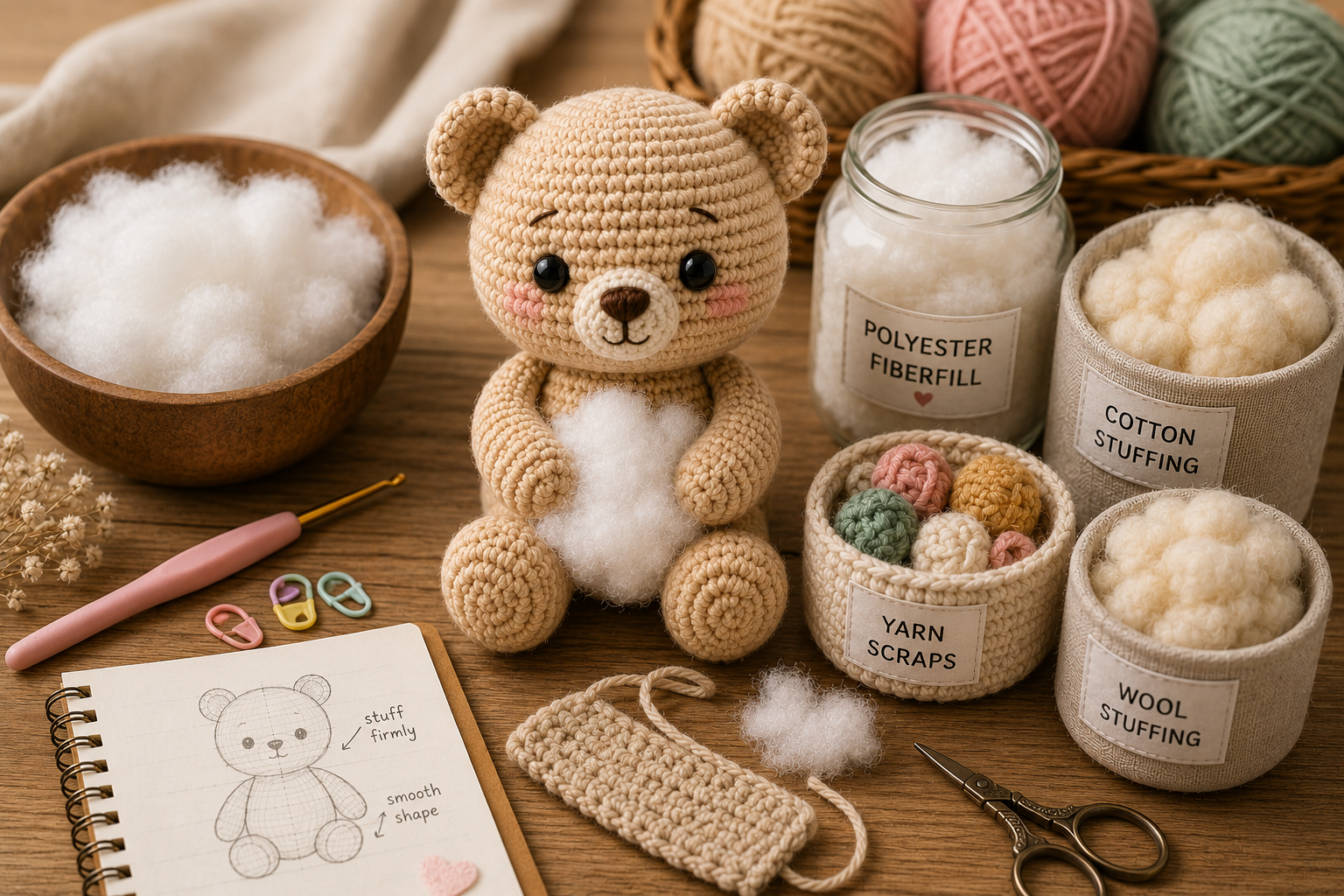
1. Polyester Fiberfill
Polyester fiberfill is probably the most commonly used stuffing material for amigurumi.
It’s lightweight, soft, widely available, and relatively easy to work with. The fibers can be separated into small portions, allowing you to gradually fill even tiny crochet pieces.
This makes polyester particularly useful for:
- heads
- bodies
- arms
- legs
- tails
- small accessories
Another advantage is its resilience. Quality polyester filling tends to spring back into shape when compressed rather than remaining permanently flattened.
For most general amigurumi projects, polyester fiberfill is an excellent starting point.
Advantages
Polyester filling is lightweight, inexpensive, easy to shape, and available in many craft stores. It’s also suitable for many washable projects, although you should always check the manufacturer’s care instructions.
Potential disadvantages
Low-quality polyester filling can sometimes clump together, particularly after repeated handling or washing.
It can also be tempting to push large handfuls into the piece at once, which often creates lumps.
For the best results, separate the fiberfill into smaller pieces before inserting it.
2. Cotton Stuffing
Natural cotton can also be used as amigurumi filling.
Compared with polyester, cotton generally creates a denser and heavier result.
This can be useful when you want a character to feel more substantial rather than extremely lightweight.
Cotton is also appealing to makers who prefer natural fibers, particularly when the outer yarn is cotton as well.
However, cotton behaves differently from polyester.
It doesn’t usually have the same springy quality, so it can compress more permanently over time. It may also absorb more moisture and take longer to dry after washing.
For decorative amigurumi that won’t be washed frequently, cotton can still be an attractive option.
3. Wool Stuffing
Wool is another natural alternative.
Wool filling can create a soft but structured interior and works particularly well for makers who prefer using natural materials throughout their projects.
One useful characteristic of wool is that the fibers tend to grip each other, helping the stuffing stay where it’s positioned.
This can make detailed shaping easier.
However, wool is generally more expensive than polyester fiberfill and may not be ideal for every recipient due to sensitivities or care requirements.
If you’re creating an amigurumi intended to be washed regularly, check how both the yarn and the wool filling respond to washing before using this combination.
4. Yarn Scraps
If you crochet regularly, you probably accumulate small pieces of leftover yarn.
These scraps can sometimes be used as stuffing rather than being thrown away.
This approach can reduce waste and works especially well for small decorative projects.
However, yarn scraps behave very differently from fiberfill.
They tend to create a heavier, denser interior and don’t distribute as smoothly.
If large pieces are pushed into a lightly crocheted body, they may create visible lumps.
Cutting scraps into smaller pieces can help, but this method still generally produces a firmer result than traditional fiberfill.
Yarn scraps are particularly useful for:
- small decorative pieces
- firm bases
- tiny accessories
- projects where additional weight is desirable
For large round heads or smooth bodies, conventional fiberfill is usually easier to shape evenly.
5. Fabric Scraps
Small pieces of clean fabric can also be used as filling.
Like yarn scraps, fabric creates a heavier and denser result.
It’s best cut into relatively small pieces so it can be distributed more evenly throughout the amigurumi.
Avoid simply pushing a large folded piece of fabric into the body, as this can create hard edges and irregular shapes.
Fabric scraps can be useful for projects where softness isn’t the main priority, but they’re generally less suitable when you’re trying to create perfectly smooth spherical forms.
6. Foam
Foam is sometimes used in specific amigurumi projects, particularly when a firm internal structure is needed.
Instead of loose stuffing, a piece of foam can be cut into the approximate shape required and inserted into the crochet shell.
This can work for unusual designs that need to maintain a very specific form.
However, foam isn’t typically the best general-purpose filling for traditional amigurumi.
It’s less flexible than fiberfill and more difficult to distribute into small areas.
For most characters, loose filling gives you much greater control over shaping.
7. Plastic Pellets for Additional Weight
Sometimes an amigurumi needs more than softness.
You may want a character to sit upright without falling over or have a pleasantly weighted base.
Plastic pellets can help.
Rather than filling the entire character with pellets, they’re usually added in a small amount at the bottom of the body and surrounded by regular stuffing.
The pellets should be placed inside a securely closed fabric pouch or another appropriate inner container before being inserted into the amigurumi.
This prevents individual pellets from working their way between crochet stitches.
Weighted filling can be particularly helpful for:
- sitting animals
- dolls
- shelf decorations
- characters with oversized heads
- designs with narrow bases
Always consider the intended recipient before using small internal components, particularly when making toys for children.
8. Avoid Materials That Break Down Easily
Not every soft material is suitable for amigurumi.
Materials that crumble, deteriorate, absorb excessive moisture, or become permanently compressed may cause problems over time.
Likewise, stuffing shouldn’t contain sharp, rough, or irregular pieces that could damage the yarn from inside.
The filling will remain enclosed in the toy for potentially many years, so durability matters.
Choose materials that maintain their structure and are appropriate for the expected use of the finished piece.
How Much Stuffing Should You Use?
Choosing the right material is only half of the process.
The amount of stuffing matters just as much.
A common beginner mistake is assuming that more filling always creates a better shape.
It doesn’t.
Understuffing can cause the amigurumi to look collapsed, wrinkled, or uneven.
Overstuffing creates the opposite problem.
Too much pressure from inside can:
- stretch stitches apart
- expose stuffing through gaps
- distort proportions
- make the toy excessively hard
- create bulges
- change the intended shape
The ideal amount is usually firm enough to support the shape but not so firm that the crochet fabric is visibly stretched.
Stuff Gradually Instead of All at Once
One of the easiest ways to improve your amigurumi finishing is to add stuffing gradually.
Take a small amount of fiberfill and separate it with your fingers.
Insert it into the piece.
Add another small amount.
Continue slowly while checking the shape from different angles.
This method takes longer than pushing a large handful inside, but it produces a much smoother result.
Large clumps tend to remain visible underneath the crochet surface.
Small portions can be distributed more evenly.
Use a Stuffing Tool for Small Areas
Your fingers may not be able to reach narrow limbs, ears, muzzles, tails, or other small sections.
A stuffing tool can help push filling into these areas.
Depending on the project, you can use a dedicated stuffing tool or another smooth, blunt object.
Avoid sharp objects that could split the yarn or push through the crochet fabric.
For extremely narrow pieces, add stuffing while crocheting instead of waiting until the entire component is finished.
Once a long arm or leg has been completed, reaching the bottom can become surprisingly difficult.
Pay Attention to the Head
The head is often the most visually important part of an amigurumi, so stuffing it correctly deserves extra attention.
Add filling gradually and rotate the head frequently.
Look at it from:
- the front
- both sides
- above
- below
Check whether the shape remains symmetrical.
If one side appears flatter, you may need to move some filling toward that area.
If the head looks unusually elongated, there may be too much stuffing pushing vertically.
Use your fingers to massage and redistribute the filling before closing the opening.
Don’t Stuff Every Part Equally
Different parts of an amigurumi may require different levels of firmness.
The head and torso usually need enough filling to maintain their shape.
Arms and legs may be slightly softer, particularly if you want them to move naturally.
Some designs intentionally leave the upper part of an arm almost unstuffed so it hangs more naturally from the shoulder.
Ears may need very little filling or none at all.
A tail may require firm stuffing near its base but softer filling toward the tip.
Follow the intended shape rather than automatically stuffing every component to the same firmness.
Choosing Stuffing for Large Amigurumi
Large amigurumi can require a surprising amount of filling.
For oversized projects, lightweight polyester fiberfill is usually practical because it provides volume without making the finished piece extremely heavy.
Even then, large areas should be filled gradually.
Pay particular attention to the center of large heads and bodies.
It’s possible for the outer area to feel firm while the center remains hollow.
Push filling toward the deepest part of the piece first and gradually work outward.
Choosing Stuffing for Mini Amigurumi
Tiny amigurumi require the opposite approach.
Even a very small amount of stuffing can dramatically change the shape.
Separate fiberfill into tiny pieces before inserting it.
A narrow tool can help position the filling precisely.
For miniature arms, legs, or ears, you may need only a few fibers.
Overstuffing tiny components can easily stretch the stitches and make them disproportionately large.
Consider Washability
Before selecting stuffing, think about how the finished amigurumi will be used.
A decorative character displayed on a shelf may rarely need cleaning.
A child’s toy may need to be washed regularly.
Check the care recommendations for every major material in the project, including:
- yarn
- stuffing
- embroidery thread
- internal structures
- embellishments
Ideally, the components should have compatible care requirements.
Using washable yarn around a filling that can’t tolerate washing can create problems later.
Safety Matters for Children’s Toys
If an amigurumi is intended for a baby or young child, material selection requires additional care.
Avoid loose internal components that could potentially escape through the crochet fabric or become accessible if the toy is damaged.
Weighted pellets and other small components require particular caution.
Decorative objects attached to the outside of the toy should also be evaluated carefully.
For children’s amigurumi, durability and secure construction are more important than elaborate embellishments.
Always consider the age and intended use of the recipient when selecting materials.
Test Your Stuffing Before the Final Project
If you’re unsure which filling will work best, create a small test sphere.
Crochet two or three identical samples and fill each one differently.
For example:
Stuff one lightly.
Stuff another moderately.
Stuff the third firmly.
Compare their appearance and texture.
This simple experiment can teach you more about stuffing than trying to judge the material while it’s still inside the package.
You can also test different types of filling using the same crochet sample.
Common Stuffing Mistakes to Avoid
Several problems appear repeatedly when makers are learning how to stuff amigurumi.
The first is adding large clumps instead of small portions.
Another is waiting too long before stuffing narrow components.
Overstuffing is also extremely common, especially when trying to create a perfectly round head.
Ignoring symmetry is another mistake. Always rotate the piece while filling it.
Finally, don’t assume that stuffing will automatically correct crochet shaping problems.
Filling can refine a shape, but it can’t completely compensate for incorrect increases, decreases, or stitch counts.
Which Stuffing Is Best for Amigurumi?
For most everyday amigurumi projects, good-quality polyester fiberfill remains one of the easiest and most versatile choices.
It’s lightweight, affordable, easy to distribute, and suitable for a wide variety of shapes.
However, “best” depends on your project.
Cotton or wool may appeal to makers looking for natural alternatives.
Yarn and fabric scraps can reduce waste and add weight.
Pellets can stabilize characters that need a heavier base.
Some projects may even benefit from combining materials.
For example, a sitting character might have a small weighted pouch in its base surrounded by polyester fiberfill throughout the rest of the body.
The important thing is to choose intentionally rather than treating stuffing as an afterthought.
Final Thoughts
The stuffing inside an amigurumi may be invisible once the project is finished, but its effect certainly isn’t.
The right filling helps your character maintain its shape, creates smooth and balanced surfaces, supports important features, and contributes to the overall feel and durability of the finished toy.
For most projects, polyester fiberfill provides a reliable starting point, while cotton, wool, yarn scraps, fabric scraps, foam, and weighted materials can be useful for specific purposes.
Whatever material you choose, technique matters just as much as the filling itself.
Add small amounts gradually, distribute them evenly, pay attention to symmetry, adjust the firmness according to each body part, and avoid stretching the crochet fabric through excessive stuffing.
Once you begin thinking of stuffing as part of the sculpting process rather than simply the final step before closing your amigurumi, you’ll have much greater control over the shape — and your finished characters will look smoother, more balanced, and more professionally made.
Clara Fern — Crochet Artist & Amigurumi Designer
Clara Fern is a crochet artist and amigurumi designer based in Austin, Texas. With 9 years of experience working with yarn and hook, she transformed a lifelong passion for handcraft into a creative mission: making amigurumi accessible, fun, and deeply rewarding for crafters of all levels.
Clara discovered amigurumi during a trip to Japan in 2017, where she fell in love with the art of bringing tiny characters to life through crochet. Back home in Texas, she spent years studying color theory, design principles, and advanced crochet techniques — developing her own signature style that blends kawaii aesthetics with original character design.
Through maclafersa.com, Clara shares everything she has learned — from choosing the right yarn and reading your first pattern, to designing fully original amigurumi characters from scratch. Her writing is known for being clear, detailed, and genuinely helpful, with no steps skipped and no secrets kept.
When she’s not crocheting, Clara enjoys watercolor painting, visiting local yarn shops, and drinking way too much coffee while sketching new character ideas.